



A saw blade sheds heat into the air around it. When that air is 25 °C, a hard rip cut can still keep the plate within a safe temperature window. When the same cut runs in a Sharjah or Jeddah joinery shop at 45 °C ambient, every part of the cooling path starts from a baseline 20 °C higher, so the plate climbs toward its limits sooner and stays there longer.
The Gulf numbers are not theoretical. In July 2024, the UAE National Center of Meteorology measured inland temperatures of 46–49 °C with peaks near 50 °C, and coastal readings of 42–45 °C. Workshops without climate control track close to those numbers. Saudi Arabia and the UAE both ban outdoor work in the midday heat between mid-June and mid-September, yet indoor production lines keep running through the same months.
Heat in the cut comes from three habits:
Dull teeth rubbing instead of shearing, which multiplies friction per pass.
A tooth count whose gullets cannot clear the chips, so packed teeth drag and burn.
A workpiece that shifts and pinches the blade inside the kerf.
Ambient temperature does not create those faults, but it compresses the margin in which saw blade overheating stays reversible. Each fault shows up sooner as burn marks, resin deposits or a warped plate.
What are the first signs of saw blade overheating?
Short answer: stop the machine when the cut edge smells scorched, when the plate shows a straw or blue tint near the rim, or when the saw develops a new whistle or squeal. A warm blade after a long run is normal. Discoloration is not.
The table below ranks the failures we see most often in hot-climate production shops, with the check a technician can run the same hour. Most overheating traces back to a setup fault rather than the blade itself, so work the table from top to bottom before ordering replacements.
| Symptom | Most likely cause | What to do |
|---|---|---|
| Scorched, toasted edge on the workpiece | Dull teeth or resin-packed gullets rubbing instead of cutting | Clean the blade, inspect tips, then resharpen or replace |
| Straw or blue tint near the rim | Plate steel passed its temper range; stiffness is going | Replace the blade. Blue steel does not recover |
| New whistle or squeal at speed | Heat plus vibration; often a dirty arbor or burred flange | Clean and check mounting; verify expansion slots carry no cracks |
| Cut wanders, blade binds mid-kerf | Uneven heating has dished the plate out of flat | Cool, check flatness on a known-flat surface, discard if dished |
| Tips chipping or lifting off | Braze joint stressed by repeated high heat | Stop using it. Tip loss at speed is a safety event, not a quality issue |
How does resin bake onto teeth, and why does Gulf heat make it worse?
Softwoods such as pine and cedar carry resin that melts during the cut and re-deposits on the carbide tips and in the gullets. Once a thin brown layer forms, every following cut drags more friction through the kerf, and the deposits bake harder with each pass. Saw blade overheating on softwood is self-accelerating: a loaded blade cuts like a dull one even when the carbide is still sharp.
Ambient heat moves the problem earlier in the shift. Resin at 45 °C is already soft before the first cut, so it wipes onto the plate instead of shattering away as chip dust. Shops that cut MDF and plywood face the same trap from the glue lines in the panel rather than from the wood itself.
The fix is a cleaning routine, not a harder push. The full cycle takes about ten minutes per blade:
Remove the blade from the machine; never clean a spinning or mounted blade.
Soak it in a pitch remover or citrus degreaser that is safe on the braze joint.
Work the residue off with a brass brush, moving from the tooth face toward the back.
Rinse and dry the plate fully, then inspect the slot ends for hairline cracks.
In hot-climate shops cutting resinous softwood, cleaning after every shift is the honest interval. Waiting a week turns a ten-minute job into a scraping session.

Laser-cut expansion slots give heated steel room to grow without dishing the plate.
What does heat do to blade tension, steel temper and brazed tips?
Short answer: saw blade overheating softens the steel, flattens the factory tension and stresses the braze joint. None of the three recovers on its own.
Steel expands when it heats, and it expands unevenly because the rim runs hotter than the clamped center. Expansion slots give the rim somewhere to grow; without them the plate dishes sideways and starts rubbing the kerf walls, which doubles the heat load. That is why a blade that "went wobbly last month" usually tells the story of one overheated day, not gradual wear.
The numbers behind the damage are specific. US saw-plate manufacturer Carbide Processors notes that a saw plate reaching roughly 1,300 °F (about 700 °C) during operation should be scrapped, and that overheated shoulder steel can shift from a tough Rockwell C in the mid-40s to a brittle level in the low 60s.
Tips are brazed at 760–840 °C (1400–1540 °F), and factories relieve that heat with a post-braze temper at 200–300 °C. A production blade that later reaches braze-range temperatures in use has no tempering step waiting for it, so tips crack or lift first.
Which blade specs hold up best in Gulf heat?
Spec choice cannot repeal thermodynamics, but it moves the margin against saw blade overheating. The machine population across UAE, Saudi and Qatari joinery shops is dominated by 250/300 mm sliding table saws with a 30 mm bore, 350 mm beam saws, and matched 160–180 mm scoring blades. The table below is the starting point GUSHI Tools quotes for hot-climate programs; confirm tooth count against your panel thickness on a sample before ordering in volume.
| Machine | Blade diameter | Teeth | Kerf | Bore | Heat-critical features |
|---|---|---|---|---|---|
| Sliding table saw (rip and crosscut) | 250–300 mm | 40–60T | 2.2–3.2 mm | 30 mm | Deep expansion slots, resin-shedding coating |
| Beam saw / panel sizing | 303–350 mm | 60–80T | confirm on sample | 30 mm | FT/TCG grind for laminates, stable tension |
| Scoring unit (used in pairs) | 160–180 mm | match main blade | kerf matched within 0.05 mm | 20 mm | Split or adjustable design for kerf matching |
| Angle grinder on site work | 100–125 mm wheel | n/a (carving wheel) | n/a | 22.23 mm | Short bursts only; wheel rated for grinder RPM |
Two features earn their cost in this market. Deep expansion slots near the teeth handle the thermal load of long rip runs, and an anti-friction coating keeps fresh resin from bonding to the plate on the first pass of the day. For gang-rip lines running multi-blade rip saw setups, ask for the same body steel across all blades so they heat and cool at the same rate.
What does a daily heat-management routine look like in a joinery shop?
Short answer: control what the operator controls, starting at the 45 °C hours. A fixed routine against saw blade overheating costs minutes and routinely adds weeks of blade life.
If the workshop exceeds 40 °C before noon, then schedule the heavy rip runs for the morning shift and give blades a cooldown pause between long sessions. UAE law already stops outdoor work between 12:00 and 15:00 from mid-June to mid-September; indoor lines can copy the same rhythm.
Set blade height so one tooth height stands above the workpiece. Exposed blade rubs more surface, and buried blades heat faster.
Feed at a steady pace. Too slow dwells the teeth in the kerf; too fast overloads them. A struggling motor sound means back off, not lean in.
Clean blades on a pitch remover after every shift on resinous softwood, and inspect expansion slot ends for hairline cracks while the blade is off the machine.
Store spare blades dry and shaded. High humidity plus heat pits the plate, and rust adds friction on the first cut.

Deep gullets clear resin-loaded chips on thick rip cuts; shallow ones overheat in dense stock.
Which documents clear a blade consignment into the GCC?
Blade life decides the second order; paperwork decides whether the first container moves. Saudi Arabia runs the SABER platform under SASO: the importer registers the product against a 12-digit HS code, obtains a Product Certificate of Conformity (PCoC) supported by test reports from an ISO/IEC 17025-accredited laboratory, and then a Shipment Certificate of Conformity (SCoC) for every consignment before arrival. From 1 January 2026, Saudi customs rejects SABER filings made with old HS code formats, so confirm the code with the importer before quoting.
The document set a Gulf buyer should expect from the supplier:
SABER Product Certificate of Conformity (PCoC), typically valid one year.
Shipment Certificate of Conformity (SCoC), issued per consignment before arrival.
English technical data sheet plus an Arabic version for tender files.
GOEIC registration support for Egypt consignments.
The UAE applies ESMA/ECAS conformity where a product falls in scope, and an Arabic data sheet alongside the English one is a practical advantage in Saudi tenders. GUSHI Tools has shipped to UAE buyers since 2004 and supplies the document set each program needs; buyers can start at our contact page or browse the wood cutting blades range, including the TCT panel sizing saw blade for beam saws and the split scoring saw blade for melamine panels.
Compliance detail changes often. Confirm current requirements on the official SABER platform for Saudi Arabia and the ESMA portal for the UAE before booking freight.
Frequently asked questions
What temperature actually damages a saw blade?
Plate steel in the 650–700 °C range (around 1,300 °F) is the scrap line per US saw-plate guidance from Carbide Processors. Visible blueing starts below that point and already signals temper loss in the affected zone. In a 45 °C workshop, the margin between a healthy long rip run and damage is smaller, so discoloration anywhere on the plate means replace, not resharpen.
Why does my blade burn pine but not MDF?
Pine and cedar deposit resin that melts under cutting heat and bakes onto the teeth, so the blade drags and burns the edge. MDF contains glue but little free resin, so it wears carbide abrasively instead of loading the gullets. If pine cuts burn after the blade is sharp and clean, the feed is probably too slow for the tooth count in use.
How often should blades be cleaned in a Gulf workshop?
After every shift on resinous softwood; weekly on MDF and plywood lines. Soak in a pitch remover or citrus degreaser safe for the braze, scrub with a brass brush, rinse, and dry fully. Never clean a blade mounted on the machine, and never use a steel brush on carbide tips.
Can a warped saw blade be flattened again?
No. Heat warp comes from steel that has lost its factory temper and tension, and re-flattening at home adds dangerous internal stress. Place the blade on a flat reference surface; if it rocks or a feeler gauge shows a gap at the rim, retire it. A cracked expansion slot end or any crack near the arbor hole is also an immediate retirement.
Which Arabic term do Gulf buyers use for these blades?
A rip blade appears in Gulf trade talk as منشار تقطيع طولي, and a circular saw blade as قرص منشار. Suppliers who quote with an Arabic data sheet alongside the English technical sheet get faster answers in Saudi tender processes, where the SABER file must match labels and documents exactly.
Does high ambient temperature change which blade I should buy?
Slightly, and the changes are worth it. Favor deep expansion slots, an anti-friction coating that resists resin bonding, and a kerf and tooth count matched to your stock rather than a universal blade. A 45 °C shop does not need a different category of blade, only one engineered to shed heat and resist loading, supported by a cleaning routine.
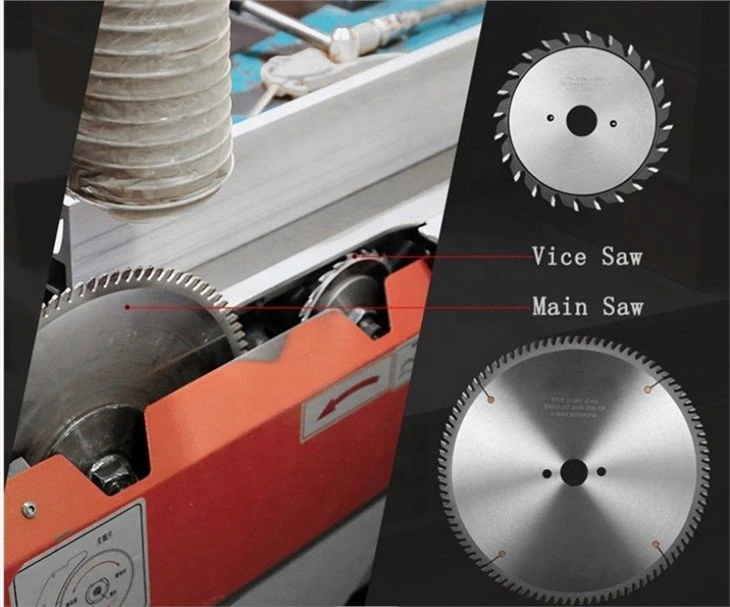
A clean plate runs cooler: baked resin on the body acts like a brake on every pass.